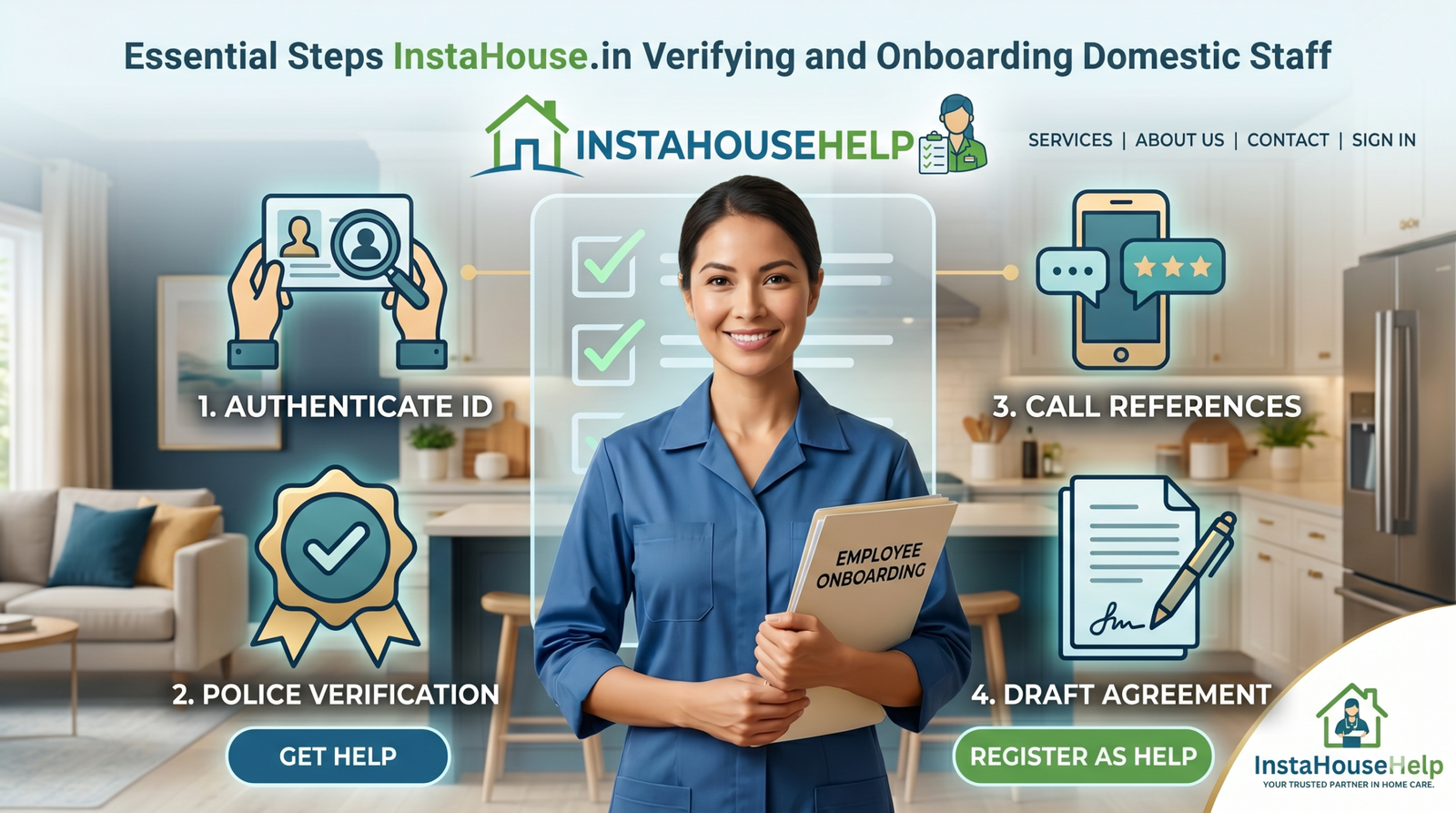
Finding the right domestic staff – whether a full-time maid, a professional cook, an infant nanny, or a patient caregiver – is only half the battle. The real challenge lies in securing your household and ensuring a smooth transition through a rigorous vetting and onboarding process.
In an increasingly unorganized sector, taking a systematic approach protects your family’s safety and establishes a professional, high-retention working relationship from day one.
Here is the definitive guide to safely verifying and onboarding domestic staff.
1. The Verification Checklist: Securing Your Household
Skipping background checks is the single biggest risk a homeowner can take. A robust verification process should always combine digital authentication with real-world validation.
Step 1: Government Identity Verification
Never accept photocopies without verifying the originals. In India, the gold standard is Aadhaar verification. Use the official UIDAI portal or a secure third-party verification app to check the validity of the Aadhaar number.
- What to collect: Two distinct government-issued IDs (Aadhaar Card, Voter ID, PAN Card, or Driving License) and two recent passport-sized photographs.
Step 2: Permanent Address Validation
Knowing where your staff resides permanently is critical for legal accountability.
- Ask for a utility bill (electricity or water) in their name or their spouse/parents’ name matching their permanent address.
- Cross-verify this with the address listed on their official identification documents.
Step 3: Mandatory Police Verification
Domestic staff police verification is legal protection. You can submit a police verification form online via your state’s digital police portal (e.g., Karnataka Police, Delhi Police web portals) or visit your local police station.
- The police will check local criminal databases for any active cases or past records associated with the individual.
Step 4: Rigorous Reference Checks
Do not just read written reference letters; place a phone call to at least two previous employers. Ask specific, open-ended questions:
- “How did they handle emergency situations in your home?”
- “What was their primary reason for leaving your employment?”
- “Were they punctual, and did they respect household boundaries?”
2. Setting Expectations: The Domestic Work Agreement
Miscommunication regarding salary, leaves, and daily duties is the leading cause of early attrition. To optimize retention, create a simple, written Household Work Agreement.
While it doesn’t need to be an complex legal contract, it must clearly define the following core parameters:
| Employment Parameter | What to Include / Specify |
| Scope of Work | Detailed list of chores (e.g., sweeping, mopping, deep cleaning kitchens, or specific meal preferences for cooks). |
| Working Hours | Exact log-in/log-out times, or specific rest-period guidelines for live-in staff. |
| Compensation Structure | Base monthly salary, overtime hourly rates, festive bonuses (e.g., Diwali/Eid bonus), and exact payout dates (e.g., by the 5th of every month). |
| Leave Policy | Number of paid leaves permitted per month, protocol for unexpected sick leaves, and notice periods required for planned time off. |
3. The 3-Day Onboarding Sequence
An orderly onboarding phase ensures your new hire understands your household’s unique ecosystem without feeling overwhelmed.
1.Day 1: Security Setup and Layout Orientation:Duration: 2 hours.
Introduce the staff to your building’s security protocols, gate management apps (like MyGate or NoBrokerHood), and biometric access if applicable. Walk them through the house, clearly demarcating private areas, storage zones, and the location of first-aid kits and fire extinguishers.
2.Day 2: Tool, Appliance, and Material Training:Duration: 1.5 hours.
Do not assume familiarity with your specific appliances. Walk through the operation of washing machines, vacuum cleaners, microwaves, or water purifiers. Specify which cleaning chemicals or detergents are used for specific surfaces (e.g., marble floors vs. wooden laminates) to avoid accidental property damage.
3.Day 3: Shadowing and Routine Finalization:Duration: Full Shift.
Let the employee execute their routine independently while you or a family member are present to answer immediate questions. At the end of the day, review the schedule together to adjust timelines if certain tasks take longer than anticipated.
4. Establishing Healthy Boundaries and Professional Respect
A high-retention household balances strict security with deep professional empathy.
- Provide Dedicated Amenities: If you employ full-time or live-in staff, ensure they have access to clean drinking water, dedicated washroom facilities, hygienic dining spaces, and a secure place to store personal belongings.
- Create an Emergency Protocol: Train your staff on what to do if an emergency occurs while you are away from home. Keep a physical card near the refrigerator containing local emergency numbers, your office contact, and a trusted neighbor’s phone number.
- Digital Discretion: Establish a clear policy regarding the use of personal smartphones during work hours, specifically emphasizing privacy—such as avoiding taking photos or videos inside the house for social media platforms.
Industry Best Practice: Consider enrolling your long-term domestic staff in basic health insurance schemes or micro-savings plans (like the Pradhan Mantri Suraksha Bima Yojana). Investing in their financial safety net drastically improves loyalty and reduces sudden absenteeism.